

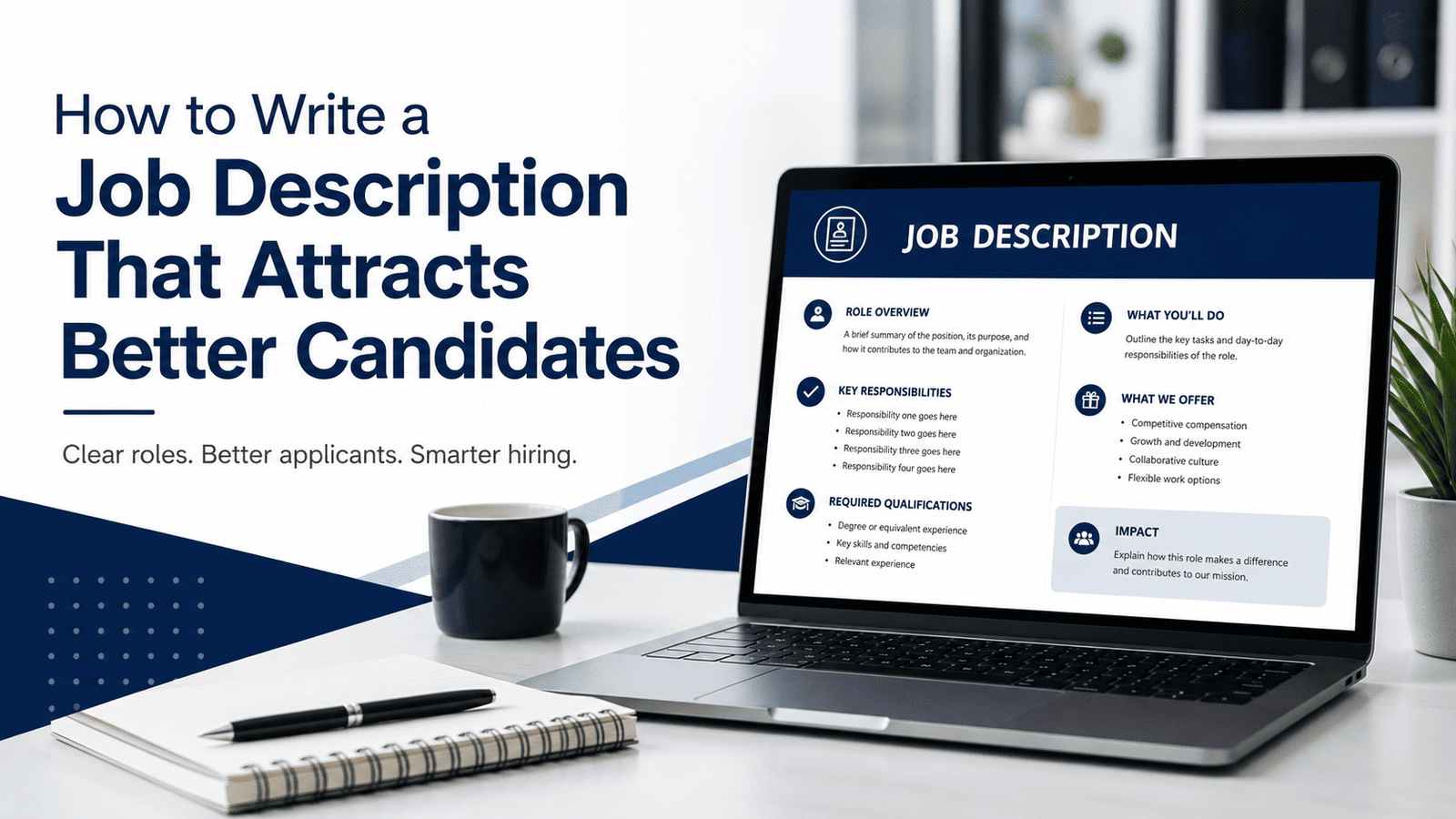
Learning how to write a job description that attracts better candidates starts with understanding what job seekers need before they apply. A strong job description should use a clear job title, explain the purpose of the role, define outcome-focused responsibilities, separate essential qualifications from preferred skills, include salary and benefits, and provide simple application instructions.
A job description should not read like an internal HR document. It should function as a candidate-focused job posting that helps qualified applicants understand the opportunity, assess their suitability and decide whether the role is worth pursuing.
What Should a Job Description Include?
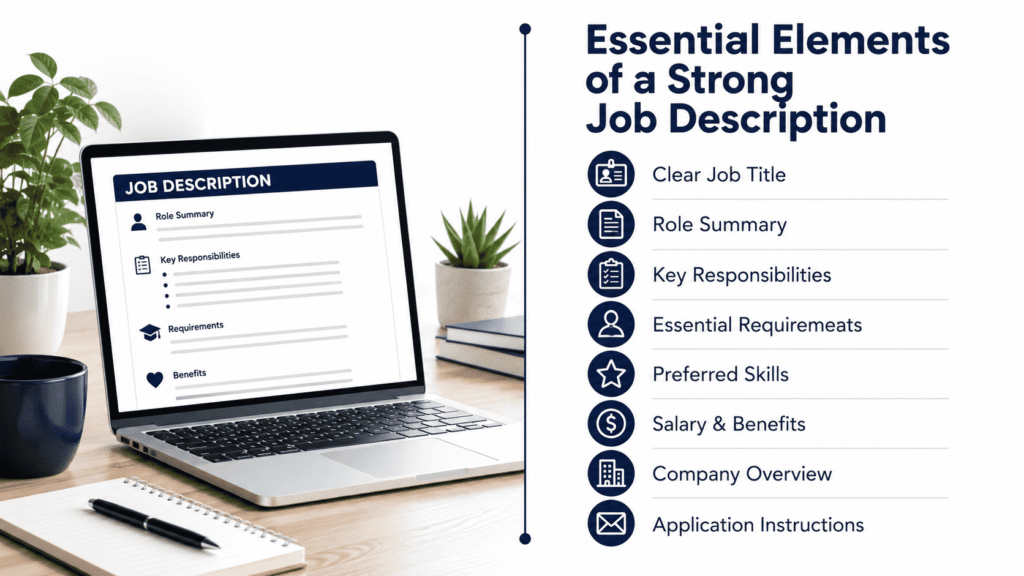
An effective job description should include:
- A clear and searchable job title
- Job location and working arrangement
- Employment type
- A concise role summary
- Key job responsibilities
- Essential qualifications
- Preferred skills and experience
- Salary range and employee benefits
- Company and team information
- Clear application instructions
These sections should appear in a logical order. Candidates should be able to understand the role, requirements and employment offer without searching through unnecessary company information.
Job Description vs. Job Advertisement
A job description explains the position, its responsibilities and the qualifications required to perform it. A job advertisement promotes the vacancy and encourages suitable candidates to apply.
In practice, a strong online job posting should combine both functions. It should describe the role accurately while also presenting the opportunity in a clear and persuasive way.
An internal position description should not be published without editing. Internal documents often contain reporting codes, policy language and administrative details that provide little value to external candidates.
How to Write a Job Description in 7 Steps
1. Use a Clear and Searchable Job Title
The job title influences how easily candidates can find the vacancy on job boards and search engines.
Employers should use the title that qualified candidates are most likely to search for. Internal or creative job titles may sound distinctive, but they can reduce visibility and create confusion.
For example:
| Avoid | Use instead |
|---|---|
| Marketing Rockstar | Digital Marketing Manager |
| Customer Happiness Hero | Customer Service Representative |
| Sales Ninja | Sales Executive |
| People Champion | Human Resources Coordinator |
The title should also match the actual seniority of the role. A junior position should not be labelled as a management role merely to attract more clicks.
A strong job title is:
- Commonly used within the industry
- Specific to the role
- Accurate in terms of seniority
- Free from unnecessary abbreviations
- Aligned with candidate search behaviour
2. Write a Candidate-Focused Role Summary
The role summary should explain the opportunity in approximately three or four sentences. It should tell candidates what the employee will do, why the position exists and what impact the role will have.
A weak role summary usually focuses only on the employer:
The company is looking for an experienced professional to perform marketing duties and support different departments.
A stronger role summary provides specific information:
The company is hiring a Digital Marketing Manager to plan and manage campaigns across paid search, social media and email. The successful candidate will be responsible for increasing qualified leads, improving campaign performance and supporting revenue growth. The role is suitable for a data-driven marketer with experience managing multi-channel campaigns.
The improved version includes the role title, marketing channels, expected outcomes and ideal candidate profile.
A good role summary should answer:
- What is the main purpose of the role?
- Which team will the employee join?
- What will the employee be responsible for?
- What type of candidate is likely to succeed?
3. Define Outcome-Focused Job Responsibilities
Job responsibilities should describe ownership and results rather than listing routine tasks.
Vague duties make it difficult for candidates to understand the scope of the position. Outcome-focused responsibilities show what the employee will manage, improve or deliver.
| Generic duty | Strong responsibility |
|---|---|
| Manage social media | Plan and manage social media campaigns that increase engagement and qualified enquiries |
| Prepare reports | Produce monthly performance reports and present recommendations to senior management |
| Help customers | Resolve customer enquiries while maintaining service-quality targets |
| Support sales | Collaborate with the sales team to improve lead quality and follow-up processes |
| Update website content | Maintain landing-page content and improve pages based on campaign performance |
A useful job responsibility formula is:
Action verb + area of ownership + expected outcome
For example:
Analyse paid advertising campaigns and recommend budget changes that improve return on advertising spend.
Most job descriptions should contain five to eight core responsibilities. Adding every possible task can make the role appear unfocused and more demanding than it actually is.
Useful action verbs include:
- Manage
- Develop
- Coordinate
- Analyse
- Lead
- Deliver
- Monitor
- Improve
- Create
- Implement
4. Separate Essential Qualifications From Preferred Skills
One of the most common job description mistakes is placing every desirable qualification in the required-skills section.
Essential qualifications are the skills, licences or experience a candidate must possess to perform the role successfully.
They may include:
- Mandatory professional certification
- Required technical knowledge
- Relevant work experience
- Legal eligibility to work
- Language proficiency needed for the position
- Safety or regulatory qualifications
Preferred skills are valuable but not necessary. They may include:
- Experience in a related industry
- Familiarity with specific software
- Additional certifications
- Knowledge of a particular customer group
- Experience with a similar business model
Before listing a requirement as essential, the hiring team should ask:
Would a strong candidate still receive an interview without this qualification?
When the answer is yes, the qualification should normally be listed as preferred.
Separating must-have requirements from nice-to-have skills helps employers attract a broader and more relevant candidate pool without lowering hiring standards.
5. Include Salary, Benefits and Working Arrangements
A transparent job description should clearly explain what the employer is offering.
Important details include:
- Salary or salary range
- Bonus or commission structure
- Full-time, part-time or contract status
- Working hours
- Remote, hybrid or on-site arrangements
- Office location
- Paid leave
- Training and development opportunities
- Health or wellness benefits
- Equipment or travel allowances
Terms such as “competitive salary” and “excellent benefits” are too vague to help candidates make an informed decision.
A stated salary range allows applicants to assess whether the opportunity matches their expectations before entering the recruitment process. Clear working arrangements also prevent misunderstandings about office attendance, location and scheduling.
6. Describe the Company and Team Specifically
The company section should give candidates enough context to understand the workplace without turning into a long company profile.
It should briefly explain:
- What the organisation does
- Which customers or markets it serves
- The size or structure of the relevant team
- How employees work together
- What makes the opportunity different
Generic phrases such as “fast-paced culture” or “great working environment” provide little useful information.
A stronger description uses specific details:
The employee will join a six-person marketing team that works closely with sales and product departments. Weekly planning meetings are used to set priorities, while team members manage their own campaign schedules. The company also provides an annual professional-development budget.
This gives candidates a clearer picture of the team structure, management style and development opportunities.
7. Add Clear Application Instructions
The final section should tell candidates exactly how to apply.
It should include:
- Where to submit the application
- Which documents are required
- Whether a cover letter is necessary
- The application deadline
- The expected interview stages
- When shortlisted candidates may receive a response
For example:
Submit a resume and a short cover letter explaining your relevant experience. Applications close on 30 September. Shortlisted candidates will be contacted within five business days and invited to an initial online interview.
A clear call to action reduces uncertainty and makes the application process easier to complete.
Job Description Template
The following job description template can be adapted to most professional roles.
Job Title
Use a standard, searchable title that accurately reflects the role and seniority level.
Location
State the city, region or country.
Working Arrangement
Specify whether the role is remote, hybrid or on-site.
Employment Type
State whether the position is full-time, part-time, permanent, temporary or contract-based.
Reports To
Identify the manager, team or department responsible for the position.
Role Summary
Write three or four sentences explaining:
- What the role involves
- Why the position exists
- What the employee will contribute
- What type of candidate is suitable
Key Responsibilities
List five to eight responsibilities using action verbs and expected outcomes.
Essential Qualifications
Include only the experience, technical skills, licences and capabilities required to perform the role.
Preferred Skills
List additional industry experience, software knowledge or qualifications that would be helpful but are not mandatory.
Salary and Benefits
Include the salary range, incentives, working arrangements, leave, training and other employee benefits.
About the Company
Provide a brief overview of the organisation, team and working environment.
How to Apply
Explain what candidates need to submit, where to apply and what happens after the application is received.
Common Job Description Mistakes
Using an Unclear Job Title
Creative titles may reduce job-board visibility and prevent relevant candidates from finding the vacancy.
Writing Vague Responsibilities
Statements such as “help with marketing” or “support the team” do not explain ownership, scope or expected results.
Listing Too Many Requirements
Excessive requirements can discourage capable candidates who meet the most important criteria but not every preferred qualification.
Hiding Salary and Benefits
Missing compensation information may reduce candidate confidence and cause applicants to withdraw later.
Copying an Internal Position Description
Internal documents are often too administrative and may contain terminology that external candidates do not understand.
Adding Too Much Company Information
Candidates need relevant context, not the complete history of the organisation. The role and employment offer should remain the focus.
Ignoring Inclusive Language
Gender-coded expressions, unnecessary physical requirements and culturally specific language can unintentionally discourage qualified applicants.
Job Description SEO and Job-Board Optimisation
A job description should be written for candidates first, but its structure should also help job boards and search engines understand the vacancy.
Employers should:
- Place the standard job title in the page title and main heading
- Include the job location
- State whether the position is remote, hybrid or on-site
- Mention relevant tools, qualifications and industry terms
- Use descriptive headings for responsibilities and requirements
- Include natural variations of the job title
- Avoid copying identical descriptions across several vacancies
- Keep paragraphs and lists easy to read on mobile devices
For example, a vacancy for a PPC Specialist may naturally mention:
- Paid search specialist
- Google Ads
- PPC campaign management
- Keyword research
- Bid optimisation
- Conversion tracking
- Advertising performance
- Return on ad spend
These related terms help qualified candidates and recruitment platforms understand the exact nature of the role.
Create Job Descriptions That Attract Qualified Candidates
A job description should make the role easier to find, understand and evaluate. The strongest descriptions use a searchable title, a specific role summary, measurable responsibilities, realistic requirements and transparent employment details.
By removing internal language, vague claims and unnecessary information, employers can create job postings that attract more qualified candidates and make the recruitment process more efficient.
Frequently Asked Questions
What is a job description?
A job description is a candidate-facing document that explains a role’s purpose, responsibilities, qualifications, salary, benefits, working arrangements and application process.
How should an employer write a job description?
An employer should use a clear job title, write a concise role summary, define outcome-focused responsibilities, separate essential and preferred requirements, include salary and benefits, and provide direct application instructions.
How long should a job description be?
Most job descriptions can communicate the necessary information in approximately 700 to 1,200 words. The appropriate length depends on the complexity and seniority of the position.
What makes a job description attractive to candidates?
An attractive job description is specific, transparent and easy to scan. It explains the role’s impact, provides realistic requirements and clearly states what the employer offers.
Should salary be included in a job description?
A salary or salary range should be included whenever possible. It helps candidates evaluate suitability and reduces compensation-related withdrawals later in the hiring process.
What is the difference between a job description and a job specification?
A job description explains the role and its responsibilities. A job specification focuses on the experience, qualifications and skills required from the candidate.