

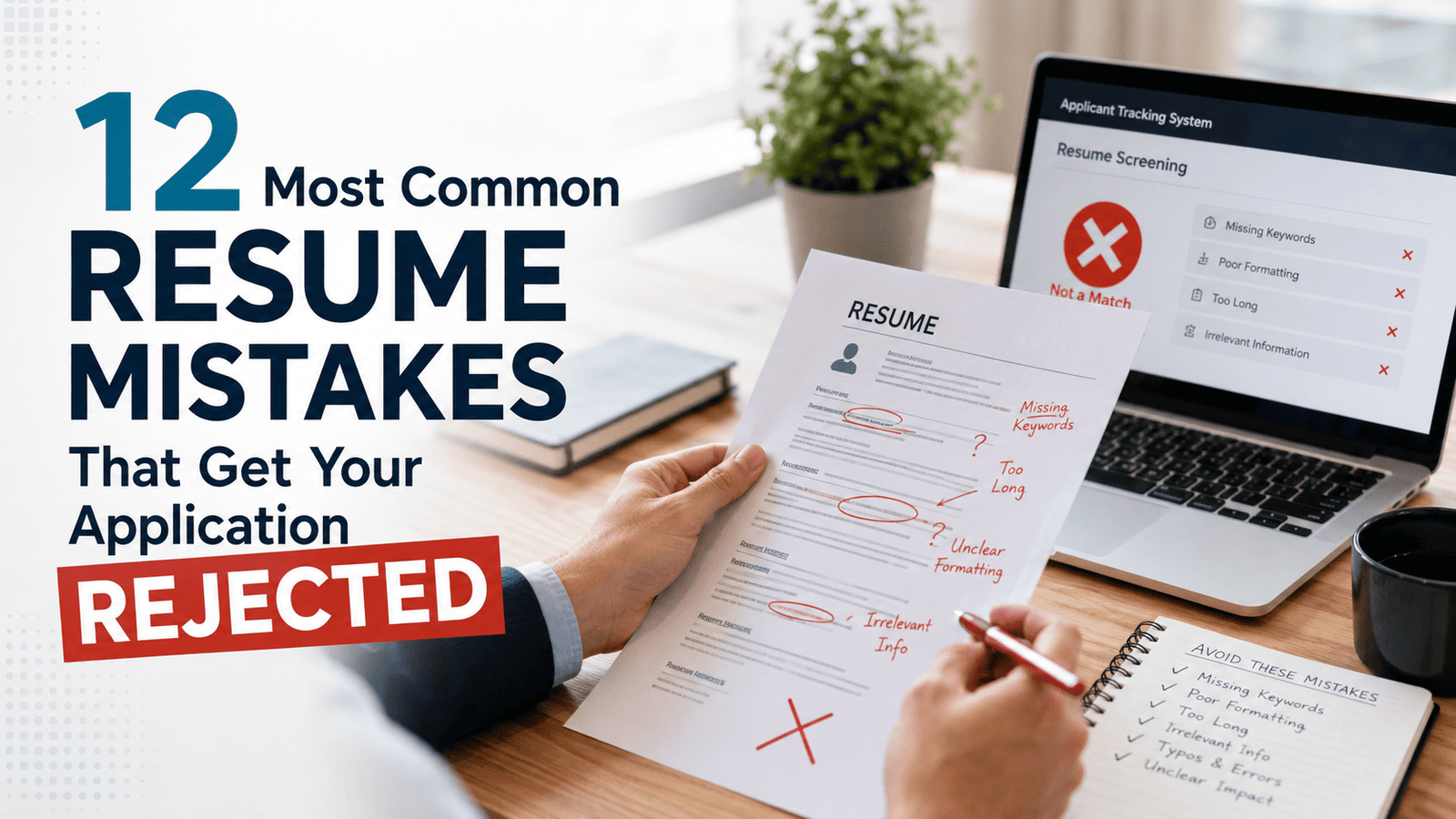
A candidate can have the right qualifications, valuable skills, and relevant experience yet still receive no response from employers. In many cases, the problem is not the candidate’s professional background. It is how that background is presented. The most common resume mistakes make it difficult for recruiters and Applicant Tracking Systems to understand whether an applicant is suitable for a position. Poor formatting, vague descriptions, missing keywords, irrelevant details, and inconsistent information can weaken an otherwise strong job application.
A resume should not be a complete record of everything a person has ever done. It should be a focused document that highlights the experience, skills, and accomplishments most relevant to a specific role.
Below are 12 common resume mistakes that can get an application rejected, along with practical ways to correct them.
Why Qualified Candidates Still Get Rejected
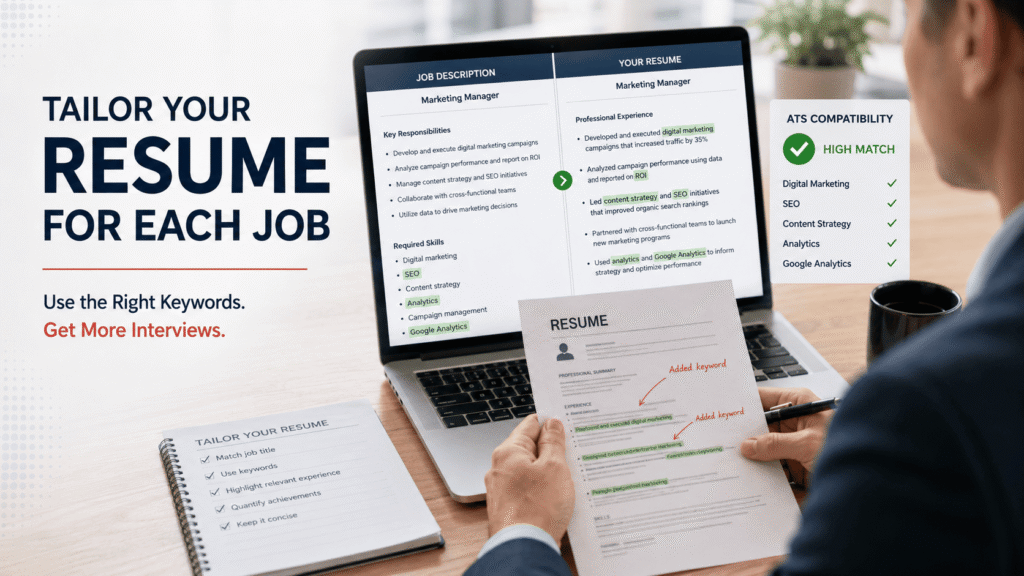
Recruiters rarely study every resume in detail during the first review. They initially look for clear evidence that the applicant meets the main requirements of the position. A strong resume makes this evidence easy to find. It highlights relevant skills, measurable achievements, recognizable job functions, and terminology connected to the job description.
A weak resume forces the recruiter to search for this information. When the connection between the candidate and the position is unclear, the application may be rejected even when the applicant has suitable experience.
Common resume rejection reasons include:
- The resume does not match the advertised role.
- Important qualifications are difficult to find.
- Work experience focuses on duties instead of results.
- The layout is difficult to read or scan.
- Relevant keywords are missing.
- Employment details are inaccurate or inconsistent.
- The resume contains unnecessary information.
1. Sending the Same Resume to Every Employer
One of the most common resume mistakes is using the same general document for every vacancy.
Two employers may advertise similar job titles while expecting different skills. One digital marketing position may focus on paid advertising, while another may prioritize search engine optimization, content strategy, email marketing, or analytics.
A resume that gives equal attention to every responsibility may not appear strongly relevant to any particular role.
Candidates do not need to rewrite their complete employment history for every application. However, several sections should be adjusted according to the job description:
- Professional summary
- Skills section
- Employment bullet points
- Software and tools
- Relevant certifications
- Major accomplishments
The experience most closely related to the target position should appear first and receive the greatest emphasis.
2. Ignoring Keywords From the Job Description
Many employers use Applicant Tracking Systems to organize, search, and review job applications. Recruiters may also search candidate databases using specific job titles, technical skills, qualifications, or industry terms.
An applicant may have the required experience but describe it using language that does not clearly match the vacancy.
For example, a job description may request experience in “customer success,” while the resume only states:
Helped customers solve problems.
A more relevant version would be:
Delivered customer success support to more than 40 business clients while maintaining a 94% satisfaction rating.
The improved statement uses recognizable terminology and provides evidence of performance.
Important resume keywords may include:
- Job titles
- Technical skills
- Certifications
- Software platforms
- Industry terminology
- Products or services
- Required qualifications
- Core job responsibilities
Keywords should only be included when they accurately represent the candidate’s knowledge and experience.
3. Stuffing the Resume With Keywords
Missing important keywords can reduce relevance, but excessive repetition can create another problem.
Some applicants copy complete phrases from a job description and repeat them throughout their resumes. This can make the content sound unnatural, vague, and unreliable.
A skills section containing every term from the vacancy is not convincing unless the work experience explains where and how those skills were used.
Weak example:
Leadership, project management, reporting, communication, analysis, teamwork, and team management.
Stronger example:
Led a six-person project team, improved weekly reporting accuracy, and completed three client implementations ahead of schedule.
The stronger version connects relevant skills with actions and outcomes.
Keywords should appear naturally in the professional summary, skills section, work experience, project descriptions, education, and certifications. They should support the candidate’s experience rather than replace it.
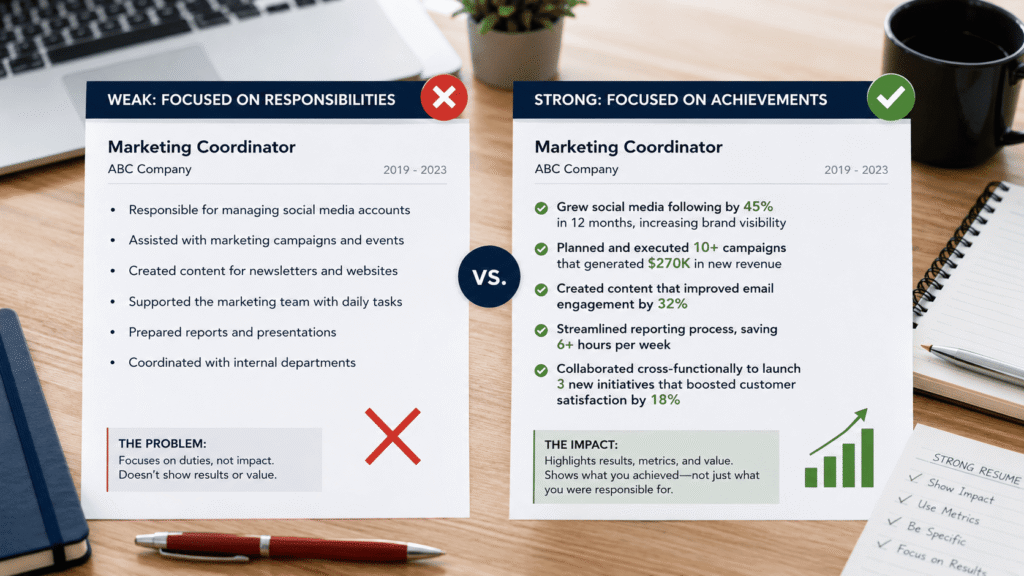
4. Listing Responsibilities Instead of Achievements
A resume should not read like a copied job description.
Recruiters usually understand the basic responsibilities associated with common positions. They are more interested in how effectively the applicant performed those responsibilities and what changed because of the work.
Weak bullet point:
Responsible for managing social media accounts.
Stronger bullet point:
Managed five social media accounts and increased average monthly engagement by 38% through audience research and content testing.
A strong resume bullet generally includes three elements:
Action + responsibility + result
Another example:
Weak bullet point:
Handled customer complaints.
Stronger bullet point:
Resolved an average of 35 customer cases per day while maintaining a 93% customer satisfaction rating.
When exact figures are unavailable, candidates can still describe the scope or impact of their work. Useful phrases may include:
- Reduced processing delays
- Improved reporting accuracy
- Shortened response times
- Supported a successful product launch
- Increased team productivity
- Improved customer retention
The objective is to demonstrate contribution rather than simply describe routine duties.
5. Using a Generic Professional Summary
The professional summary occupies valuable space at the top of a resume. It should quickly explain who the candidate is, what experience they have, and how they can contribute.
Generic statements such as “hardworking individual seeking a challenging opportunity” provide little useful information.
Weak professional summary:
Motivated professional looking for a position in a successful company.
Stronger professional summary:
Digital marketing specialist with four years of experience in paid advertising, search optimization, and e-commerce campaigns. Experienced in managing Google and Meta advertising budgets while improving qualified lead generation for service-based businesses.
An effective professional summary may include:
- Professional role or specialization
- Approximate level of experience
- Relevant technical or industry skills
- One credible accomplishment
- The type of position being targeted
The summary should remain concise and should be supported by information included elsewhere in the resume.
6. Choosing an ATS-Unfriendly Resume Layout
A visually creative resume is not always an effective resume.
Complicated columns, text boxes, graphics, icons, tables, headers, and footers may cause some recruitment systems to extract information in the wrong order. These design elements can also make it harder for recruiters to locate important details quickly.
An ATS-friendly resume generally includes:
- A clear reading order
- Standard section headings
- Consistent spacing
- Conventional fonts
- Text-based bullet points
- Simple formatting
- The file type requested by the employer
Recognizable section headings include:
- Professional Summary
- Work Experience
- Education
- Skills
- Certifications
- Projects
Candidates should avoid replacing standard headings with creative alternatives such as “My Journey,” “What I Bring,” or “Career Story.”
A clean, text-based PDF or DOCX file may work correctly, depending on the employer’s system. Scanned documents, image-based resumes, and highly complex layouts create a greater risk of parsing problems.
The employer’s file-format instructions should always take priority.
7. Including Spelling and Grammar Errors
A single typo may not prove that a candidate lacks ability. However, repeated errors can make a resume appear rushed, careless, or poorly reviewed.
Common resume errors include:
- Incorrect verb tense
- Misspelled company names
- Misspelled software names
- Inconsistent capitalization
- Missing words
- Incorrect employment dates
- Uneven punctuation
- Inconsistent bullet-point formatting
Candidates should not rely entirely on automated spelling tools. A word can be spelled correctly but still be incorrect in context.
A reliable proofreading process includes:
- Reading the resume aloud.
- Checking contact information separately.
- Confirming every employment date.
- Reviewing job titles and company names.
- Checking verb tense consistency.
- Reading the document again after a break.
- Asking another person to review it.
Proofreading is especially important for positions involving communication, administration, reporting, documentation, customer service, or attention to detail.
8. Making the Resume Too Long or Too Short
Resume length should reflect relevant experience rather than an arbitrary page target.
A recent graduate may be able to present education, internships, projects, and skills on one page. An experienced professional may need two pages to explain important responsibilities and accomplishments.
Longer resumes may occasionally be appropriate for senior, technical, academic, or highly specialized careers. However, every section should provide clear value.
Candidates should consider removing:
- Old jobs unrelated to the target role
- Repeated responsibilities
- Outdated software skills
- Unnecessary personal details
- Long explanations of basic tasks
- References available upon request
- Hobbies unrelated to the position
A short resume is not automatically better. It must still provide enough evidence to demonstrate that the applicant is suitable for the position.
The objective is relevance and clarity, not simply reducing the page count.
9. Adding Irrelevant or Outdated Information
Every resume section should help answer one important question:
Does this candidate have the experience and qualifications required for the position?
Information that does not support that answer can distract from stronger material.
For example, a senior accountant may not need to describe an unrelated temporary job from 15 years earlier. However, an early-career applicant may include part-time work when it demonstrates valuable transferable skills.
Relevant transferable skills may include:
- Customer service
- Communication
- Cash handling
- Time management
- Team coordination
- Problem-solving
- Record keeping
- Sales
Experience should not automatically be removed because it comes from a different industry. The candidate should determine whether it provides evidence of a skill required by the new employer.
The resume should function as a carefully selected professional story, not a complete autobiography.
10. Using Generic AI-Generated Language
AI writing tools can help organize ideas, improve sentence clarity, and identify missing information. Problems arise when applicants copy generic output without adapting it to their actual experience.
Phrases such as the following may sound professional but provide little evidence:
- Results-driven professional
- Dynamic team player
- Strategic thinker
- Highly motivated individual
- Excellent communicator
- Proven problem-solver
These descriptions become more useful when supported by specific details.
Generic statement:
Results-driven sales professional with excellent communication skills.
Specific statement:
Sales professional with three years of experience managing B2B accounts and increasing monthly repeat orders by 24%.
Candidates should improve AI-assisted content by adding details such as:
- Team size
- Project scope
- Software used
- Customers served
- Revenue influenced
- Processes improved
- Time saved
- Problems solved
The final resume should sound natural, accurate, and easy for the candidate to explain during an interview.
11. Providing Incorrect or Inconsistent Contact Information
An impressive resume cannot generate an interview when an employer cannot contact the applicant.
Candidates should confirm that the resume includes:
- A professional email address
- A correct phone number
- The appropriate country code
- A working LinkedIn profile link
- An updated portfolio link
- A suitable city or regional location
An email address based on the candidate’s name usually appears more professional than one containing jokes, nicknames, or unrelated words.
Career information should also remain consistent across the resume, LinkedIn profile, portfolio, and application form.
Recruiters may question differences involving:
- Employment dates
- Job titles
- Company names
- Qualifications
- Certification dates
- Career gaps
A LinkedIn profile does not need to copy the resume word for word. However, the basic facts should remain consistent.
Applicants should also test every link before submitting the application. A broken portfolio or LinkedIn URL may prevent recruiters from reviewing additional evidence of the candidate’s work.
12. Exaggerating Skills or Employment Experience
Some candidates feel tempted to increase job titles, extend employment dates, or claim technical skills they have not fully developed.
These changes may make the resume appear stronger initially, but they can create serious problems during:
- Interviews
- Skills assessments
- Reference checks
- Employment verification
- Background screening
- Probation periods
A more effective approach is to describe genuine experience confidently and accurately.
Instead of falsely claiming advanced expertise, a candidate could write:
Working knowledge of Power BI, including dashboard editing, data cleaning, and monthly performance reporting.
This statement communicates useful experience without overstating the candidate’s ability.
Employment gaps and career changes should also be handled honestly. A brief and accurate explanation is more credible than altered dates or invented employment.
Honest positioning does not require candidates to minimize their achievements. It requires them to present those achievements accurately and with enough detail to demonstrate their value.
Quick Resume Review Checklist
Before submitting an application, candidates should confirm that the resume:
- Targets the specific position.
- Uses relevant keywords naturally.
- Includes standard section headings.
- Focuses on achievements rather than duties.
- Contains measurable results where possible.
- Uses a clean and readable layout.
- Has accurate contact information.
- Includes correct employment dates.
- Matches the candidate’s LinkedIn profile.
- Contains no spelling or grammar errors.
- Avoids exaggerated or unsupported claims.
- Uses the employer’s requested file format.
- Includes working portfolio and profile links.
- Removes irrelevant or outdated information.
Avoiding Resume Rejection Starts With Relevance and Proof
The most common resume mistakes that get an application rejected are not limited to spelling errors and poor design. A resume becomes ineffective when it fails to prove why an applicant is suitable for a particular position. A strong resume is relevant, readable, accurate, and supported by evidence. It connects skills with accomplishments, uses job-related terminology naturally, and presents consistent career information.
Candidates should remove generic claims, highlight measurable results, use an ATS-friendly structure, and carefully review every detail before applying. These improvements cannot guarantee an interview, but they can make the candidate’s experience easier for recruiters and recruitment systems to understand.
Frequently Asked Questions
What are the most common resume mistakes?
The most common resume mistakes include submitting an untailored resume, listing responsibilities instead of achievements, missing relevant keywords, using poor formatting, including spelling errors, and providing irrelevant or inconsistent information.
Why do resumes get rejected?
Resumes may be rejected when they do not clearly demonstrate that the applicant matches the position. Poor readability, weak descriptions, missing qualifications, inaccurate details, and formatting problems can also reduce the chances of progressing.
Should a resume be changed for every job?
The candidate’s main employment history can remain consistent, but the professional summary, skills, and most relevant bullet points should be adjusted for each opportunity. The final resume should reflect the requirements and priorities of the target job description.
Is a one-page or two-page resume better?
One page is often sufficient for graduates and early-career applicants. Two pages may be appropriate for experienced professionals when the additional information is relevant. Quality and relevance matter more than forcing every resume into the same length.
Should keywords be copied directly from a job description?
Relevant terminology can be used when it accurately represents the candidate’s experience. Complete sentences should not be copied unnecessarily, and keywords should be supported by accomplishments, responsibilities, or practical examples.
Should every resume include a professional summary?
A professional summary can be valuable when it clearly explains the applicant’s specialization, experience, and strongest qualifications. However, a generic summary that adds no useful information may waste valuable space.