

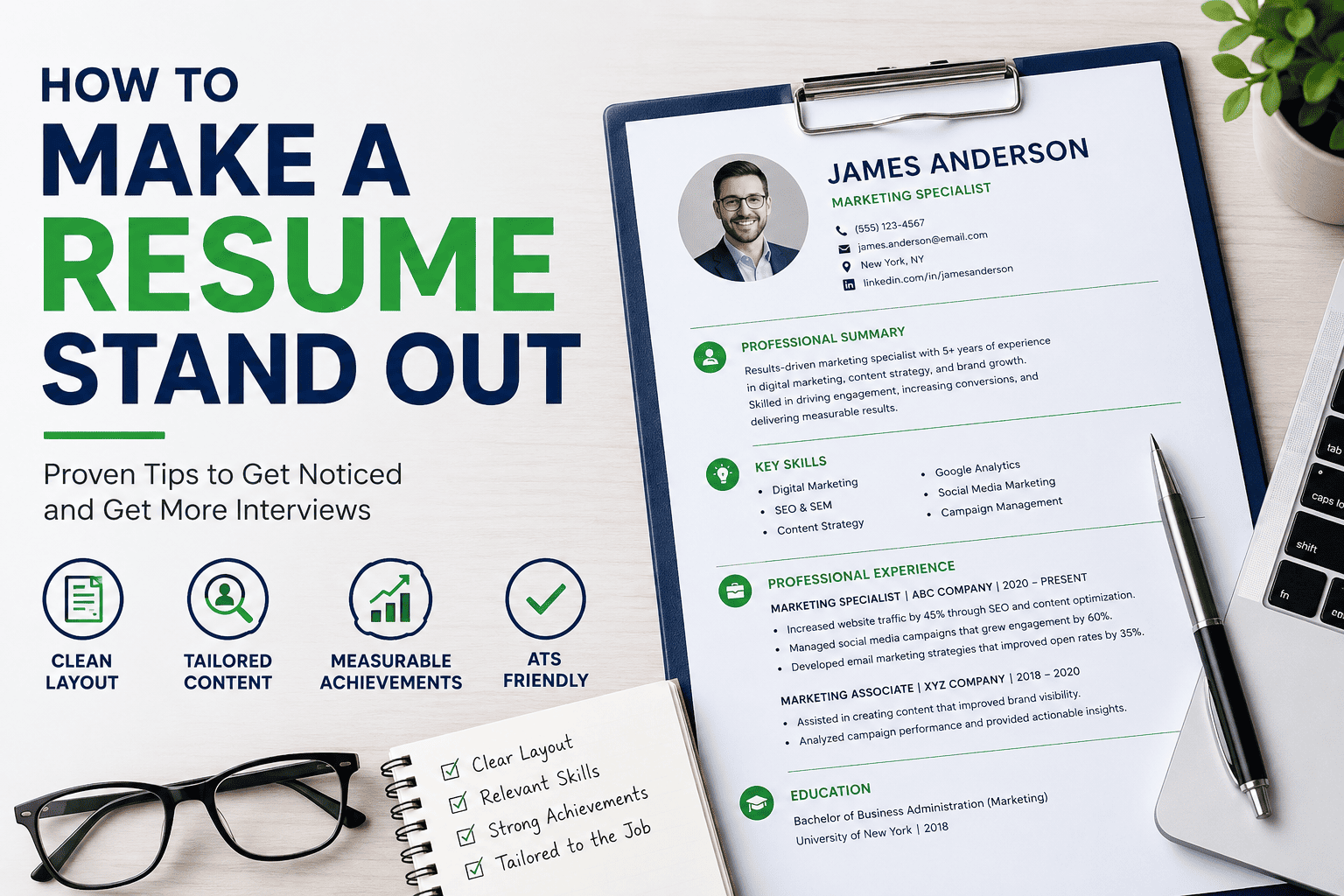
Learning how to make a resume stand out is no longer just about choosing a nice template or adding a long list of skills. A strong resume should quickly show who the candidate is, what they can do, and why they are right for the role. In simple terms, the best way to make a resume stand out is to keep it clean, tailor it to the job description, use relevant resume keywords naturally, highlight measurable achievements, and make the content easy for both hiring managers and applicant tracking systems to scan. The strongest resumes are not only attractive; they are focused, honest, and built around the job a person wants, not just the jobs they have already done.
A resume is often the first professional impression a candidate makes. Before scheduling an interview, recruiters usually look for signs of relevant experience, career direction, measurable results, and attention to detail. That means every section of the resume should have a purpose. A job seeker does not need to make the resume complicated. In most cases, a simple, well-written, and properly structured resume performs better than a crowded design filled with graphics, vague phrases, and unnecessary details.
Why a Resume Needs to Stand Out Quickly
Hiring teams often review many applications for one role. Because of that, a resume should communicate value quickly. If the layout is confusing, the summary is generic, or the experience section only lists daily duties, the reader may move on before understanding the candidate’s strengths.
A standout resume helps the reader answer three questions fast:
What role is this person suitable for?
What skills and experience make this person qualified?
What results has this person achieved in previous roles?
What skills and experience make this person qualified?
What results has this person achieved in previous roles?
When a resume answers these questions clearly, it becomes easier for recruiters and hiring managers to shortlist the candidate.
Start With a Clean and Professional Resume Layout
The first step in making a resume stand out is improving its layout. A good resume should be visually clean, easy to read, and consistent from top to bottom. Job seekers should use clear headings, balanced spacing, readable fonts, and a simple structure that guides the reader through the page.
A professional resume layout usually includes:
- Name and contact information
- Professional summary
- Key skills
- Work experience
- Education
- Certifications or relevant training
- Projects, achievements, or additional sections if needed
A resume does not need heavy colors, large icons, photos, charts, or decorative graphics. These elements may look attractive at first, but they can distract from the actual content. In some cases, they may also make the resume harder for applicant tracking systems to read. A simple design with strong content usually creates a better impression.
For most professionals, a one-page resume is suitable if they have limited experience. A two-page resume can work well for experienced professionals, managers, technical specialists, or candidates with several relevant roles. The main goal is not to make the resume as short as possible. The goal is to make every line useful.
Write a Strong Professional Summary
A professional summary is one of the most important parts of a modern resume. It appears near the top and gives the reader a quick overview of the candidate’s background, strengths, and career direction.
A weak summary sounds generic:
“Hardworking and motivated professional looking for a good opportunity to grow.”
A stronger summary is specific:
“Digital marketing specialist with three years of experience in SEO, paid ads, content strategy, and lead generation. Skilled in improving website visibility, managing campaigns, and creating performance-focused marketing reports for service-based businesses.”
The second example is better because it tells the reader what the candidate does, what skills they bring, and what type of value they can provide. A strong resume summary should be short, direct, and relevant to the target job.
Match the Resume With the Job Description
One of the biggest resume mistakes is sending the same version to every employer. A resume stands out more when it is tailored to the job description. This does not mean a candidate should change facts or exaggerate experience. It means the most relevant skills, achievements, and keywords should be placed where the recruiter can easily see them.
Before applying, a candidate should review the job posting and identify important words related to:
- Required skills
- Tools and software
- Job responsibilities
- Industry experience
- Certifications
- Soft skills
- Performance expectations
For example, if a job description mentions “project management,” “client communication,” and “budget tracking,” a qualified candidate should naturally include those terms in the resume where they match real experience. This helps both the recruiter and the applicant tracking system understand the fit between the candidate and the role.
Use Resume Keywords Naturally
Resume keywords are important because many companies use applicant tracking systems to organize, scan, or filter applications. These systems may look for words and phrases that match the job description. However, keyword stuffing can make a resume look unnatural and unprofessional.
The better approach is to use keywords in context. Instead of adding a random skills list, a candidate should connect keywords to real work examples.
Weak example:
“SEO, content, ranking, keywords, Google, analytics, website.”
Strong example:
“Improved organic website traffic by optimizing service pages, updating keyword placement, fixing on-page SEO issues, and monitoring performance through Google Analytics and Search Console.”
This version includes relevant keywords and also shows action and impact. That is what makes it more useful for both systems and human readers.
Focus on Achievements, Not Only Duties
A resume that only lists responsibilities often feels flat. Many applicants write what they were supposed to do, but not what they actually achieved. To make a resume stand out, the experience section should show results, improvements, and contributions.
A weak bullet point might say:
“Responsible for managing social media accounts.”
A stronger bullet point might say:
“Managed social media content for three business accounts and increased monthly engagement by planning weekly posts, improving captions, and tracking audience response.”
When possible, candidates should add numbers. These can include percentages, time saved, revenue improved, leads generated, projects completed, team size, budget handled, clients served, or rankings improved. Numbers make achievements easier to understand.
Good resume bullet points often begin with strong action verbs such as managed, improved, developed, created, increased, reduced, organized, led, trained, optimized, and delivered. Action verbs help the resume sound active and confident.
Weak Resume vs Strong Resume: Quick Comparison
| Resume Area | Weak Resume Approach | Strong Resume Approach |
| Summary | Uses a generic statement that could apply to anyone | Gives a clear overview of role, experience, skills, and value |
| Layout | Uses heavy graphics, random fonts, or crowded spacing | Uses clean formatting, readable sections, and consistent styling |
| Experience | Lists only daily duties | Shows achievements, responsibilities, and measurable results |
| Skills | Adds too many unrelated skills | Includes skills that match the job description and real experience |
| Keywords | Repeats keywords unnaturally | Uses relevant resume keywords naturally in context |
| Job Targeting | Sends the same resume to every employer | Tailors the resume for each role and company |
| Proofreading | Contains spelling, grammar, or formatting mistakes | Looks polished, accurate, and professional |
This comparison shows that a strong resume is not only about design. It is about clarity, relevance, and proof. A resume should help the employer quickly understand what the candidate has done and how that experience connects to the open role.
Keep the Skills Section Relevant
A skills section can help a resume stand out, but only when it is focused. Adding too many unrelated skills can weaken the resume. A candidate should choose skills that match the role and support the work experience section.
For example, a digital marketing resume may include SEO strategy, Google Ads, Meta Ads, keyword research, content writing, Google Analytics, WordPress, conversion tracking, and reporting.
A customer service resume may include client communication, complaint handling, CRM software, problem-solving, order support, time management, and team coordination.
The skills section should not replace proof. If a candidate lists an important skill, the work experience section should show how that skill was used.
Make the Resume ATS-Friendly
An ATS-friendly resume is designed to be readable by both software and people. To improve ATS readability, job seekers should use standard headings such as “Work Experience,” “Education,” “Skills,” and “Certifications.” They should avoid placing important details inside headers, footers, images, text boxes, or complex tables.
A safe resume format usually includes:
- Simple fonts
- Clear section titles
- Standard bullet points
- Reverse chronological work history.
- Job title, company name, and dates
- Keywords from the job description
- A clean file format requested by the employer
Creative resumes may work for some design-related roles, but for most job applications, clarity is more important than decoration.
Show Career Growth and Learning
Employers often look for signs that a candidate is improving over time. A resume can stand out by showing growth, promotions, training, certifications, or new responsibilities.
If a person was promoted, the resume should make that progress clear. If a person completed a course, learned a tool, or earned a certification relevant to the target role, it should be included. This shows that the candidate is not only experienced but also committed to professional development.
For example:
“Promoted from Marketing Assistant to SEO Executive after improving content workflow and supporting monthly website optimization projects.”
This sentence conveys growth, responsibility, and performance in a single line.
Do Not Undersell Soft Skills
Soft skills matter, but they should be presented carefully. Instead of simply writing “team player” or “good communicator,” a candidate should show soft skills through examples.
Weak example:
“Excellent communication skills.”
Strong example:
“Coordinated with clients, designers, and developers to complete website updates on time and reduce revision delays.”
The stronger example proves communication skills through action. Good soft skills to highlight may include leadership, adaptability, problem-solving, teamwork, organization, attention to detail, and client communication. These should be connected to real work situations wherever possible.
Keep LinkedIn and Online Profiles Consistent
A resume is not always reviewed alone. Recruiters may also check a candidate’s LinkedIn profile, portfolio, website, or professional profiles. If the resume says one thing and the online profile says something different, it can create doubt.
A strong LinkedIn profile should support the resume by showing similar job titles, dates, skills, achievements, and career direction. It does not need to copy the resume word-for-word, but it should convey the same professional story.
For candidates in creative, technical, or marketing fields, adding a portfolio link can also help. Examples of work often make a stronger impression than claims alone.
Common Resume Mistakes to Avoid
Many resumes fail because of small but serious mistakes. Before applying, candidates should check for spelling and grammar errors, outdated contact information, long paragraphs, unclear job titles, missing dates, unrelated experience, too many design elements, generic summaries, fake skills, and using the same resume for every job.
A resume should be honest, polished, and relevant. Even one obvious error can make a recruiter question the candidate’s attention to detail.
Resume Stand-Out Checklist
Before submitting a resume, a candidate should ask:
Does the resume match the target job?
Is the professional summary specific?
Are the most important skills easy to find?
Does the experience section include achievements?
Are keywords used naturally?
Is the format clean and ATS-friendly?
Are the dates, contact details, and job titles correct?
Has the resume been proofread carefully?
Does the LinkedIn profile support the same career story?
Is the professional summary specific?
Are the most important skills easy to find?
Does the experience section include achievements?
Are keywords used naturally?
Is the format clean and ATS-friendly?
Are the dates, contact details, and job titles correct?
Has the resume been proofread carefully?
Does the LinkedIn profile support the same career story?
If the answer is yes, the resume has a stronger chance of getting noticed.
Build a Resume That Gets Noticed
Understanding how to make a resume stand out starts with one important idea: a resume should make hiring decisions easier. It should help recruiters quickly see who the candidate is, what they can do, and why their experience matters for the role.
The strongest resumes are not always the most decorative. They are the most relevant, readable, and specific. A job seeker who uses a clean layout, writes a focused summary, includes the right keywords, proves achievements with examples, and keeps the resume tailored to each job can create a much stronger application. When a resume is treated as a living career document rather than a one-time file, it becomes a powerful tool for securing more interviews and better job opportunities.
FAQ’s
How can a candidate make a resume stand out with no experience?
A candidate with no experience can make a resume stand out by focusing on education, projects, internships, volunteer work, certifications, transferable skills, and relevant coursework. The goal is to show potential, reliability, and the ability to learn quickly.
What makes a resume attractive to recruiters?
A resume is more attractive to recruiters when it is easy to scan, tailored to the role, error-free, and focused on relevant achievements. Recruiters usually prefer clear formatting, strong bullet points, measurable results, and skills that match the job description.
Should a resume include colors or graphics?
A small amount of color can be acceptable, but a resume should not depend on heavy graphics, photos, or decorative elements. A clean, simple format is usually safer, especially when applying through online systems that may scan resumes.
How long should a resume be?
A one-page resume is usually suitable for students, fresh graduates, and professionals with limited experience. A two-page resume can work better for experienced professionals, managers, or candidates with several relevant roles and achievements.
How can a resume be made ATS-friendly?
A resume can be made ATS-friendly by using standard section headings, simple formatting, relevant keywords from the job description, clear bullet points, and readable fonts. Important information should not be placed inside images, tables, headers, or footers.
What is the biggest mistake people make on a resume?
One of the biggest mistakes is listing duties without showing achievements. Employers want to know not only what a candidate was responsible for, but also what results they delivered and how their work created value.